
Tarifa old town
Puerta de Jerez, town walls and the lanes of the old town
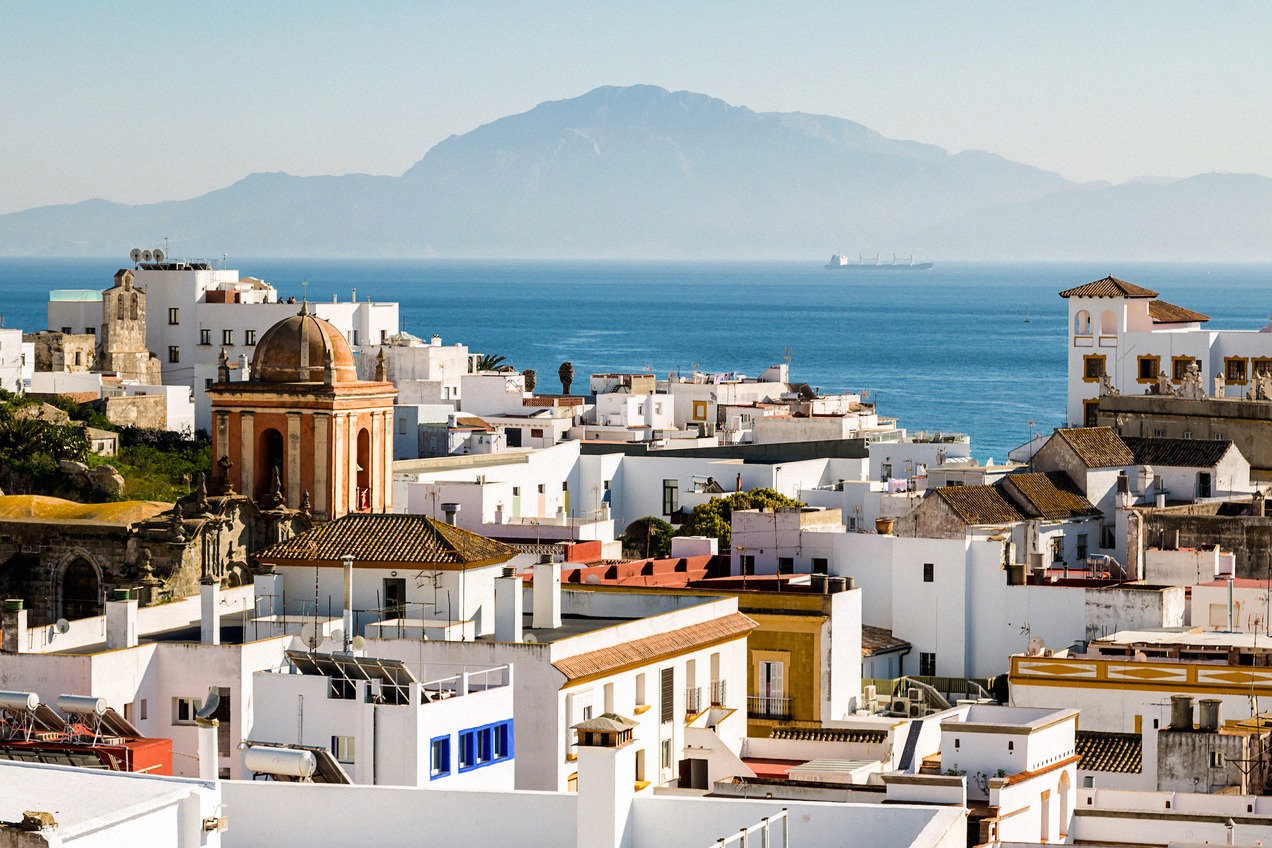
Tarifa's old town in Andalusia grew up around the 10th-century caliphal fortress, and its layout and narrow, winding lanes date from the Moorish period. The Puerta de Jerez was once the main entrance to the walled town. A walkway of almost half a kilometre runs along a restored section of the town wall.
On this page
Lanes from the Moorish period
Tarifa's old town in Andalusia sits on the Strait of Gibraltar. It began as the 10th-century caliphal fortress built under Abd al-Rahman III, now known as the Castillo de Guzmán el Bueno. The townscape and its narrow, winding lanes date from the Moorish period. Besides the castle and the town wall, the sights of the old town include the Gothic-Mudéjar Santiago chapel, the San Francisco monastery and the churches of Santa María and San Mateo.
Puerta de Jerez
The Puerta de Jerez at Calle Silos 1 stands where Avenida de Andalucía, Calle Amador de los Ríos and Calle Batalla del Salado meet. The gate was opened when the walls were extended after the Christian reconquest and was once the main entrance to the walled town. On the outside it has a brick horseshoe arch of Arab origin, and a plaque above the arch commemorates the capture of the town.
The gate was restored in 2000. Next to it hangs the painting “El Cristo de los Vientos” by the Tarifa-born artist Guillermo Pérez Villalta.
Three rings of walls and the walkway
Tarifa has three medieval rings of walls:
- the Almedina wall,
- the Aljaranda wall, whose remains can be seen in the exhibition space of the former Cárcel (jail),
- the Arrabal wall, the longest of the three, which includes the Puerta de Jerez.
Sections of the walls are visible from Calle Calzadilla de Téllez, and along the Alameda they are built into houses. The Torre de la atalaya watchtower is also part of the town wall.
Since the south-eastern section of the wall was restored, the “Tarifa por todo lo alto” walkway runs for almost half a kilometre along the top. From up there you can see across the town and, on a clear day, all the way to Africa.
Castillo de Guzmán el Bueno
The Castillo de Guzmán el Bueno stands between the old town and the port. Caliph Abd al-Rahman III ordered its construction in 960, and it is named after Alonso Pérez de Guzmán, who defended it after the Christian conquest of 1292. A visit includes exhibition rooms and the wall walk along the castle walls. The castle is open Wednesday to Sunday from 10:00 to 16:00, with last entry at 15:15.
Churches and town hall
The Iglesia Mayor de San Mateo is on Calle Sancho IV El Bravo. Its floor plan is a Latin cross with three naves, a transept and a flat chevet. The nave has four bays with pointed arches and a star-patterned rib vault.
The Iglesia de Santa María stands right next to the castle, and you can explore it on a virtual tour on the Castillo's website. The Ayuntamiento, Tarifa's town hall, is at Plaza de Santa María 3.
Driving and parking
Since 16 October 2026, Tarifa's traffic bylaw allows streets or sections of streets to be reserved for residents. They are marked by signs and road markings, and checks are made against the vehicle keeper and address held in the register of the DGT, Spain's traffic authority. Parking there illegally is a serious offence and your car may be towed away.
Blue zones with a maximum stay of two hours include Avenida de Andalucía, Calle Sancho IV El Bravo and Plaza Miramar behind the castle. Charges apply Monday to Friday from 10:00 to 20:00 and on Saturdays from 10:00 to 14:00. For how to reach Tarifa, see Getting there.
Just off the coast lies Isla de las Palomas, and Playa Chica is in the port area; more on it and the other beaches under Beaches. Other places to visit in and around town are covered in Things to do.